Homepage
Can a supercomputer perform 1000 trillion calculations per second that will actually be done by humans?
What’s so special about supercomputer?
ZetaFlops is a unit of measurement of computer performance 1 of the units of general Flops. 1 zetaFlops will correspond to 1000 trillion calculations per second.
At this speed, supercomputer will be able to process huge amounts of data and perform complex calculations quickly, opening up new applications in many fields such as artificial intelligence and scientific research.
Japan is preparing to start building the world’s first zeta-class supercomputer, with an investment budget of up to 750 million USD.
Artificial Intelligence Supercomputer and Rates Allowed to Be Calculated in Zeta Units First
According to the announcement of Japan’s Ministry of Education, Culture, Sports and Science (MEXT), Japan plans to carry out research on a new version of the supercomputer at an unprecedented speed at the zetaFLOPS scale. It is known that FLOPS (FLoating-point Operations Per Second) is a measure of computer performance, especially in the field of scientific calculations that use a lot of decimal calculations per second.
Accordingly, compared to the previous Fakuga supermachine, the new machine will be able to perform 1,000 trillion calculations per second, measured by and belonging to the zetaFLOPS unit segment. This is a major breakthrough, as the most powerful supercomputers today only reach exaFLOPS, which is a rate of 1 per second that allows for dynamic comma calculations.
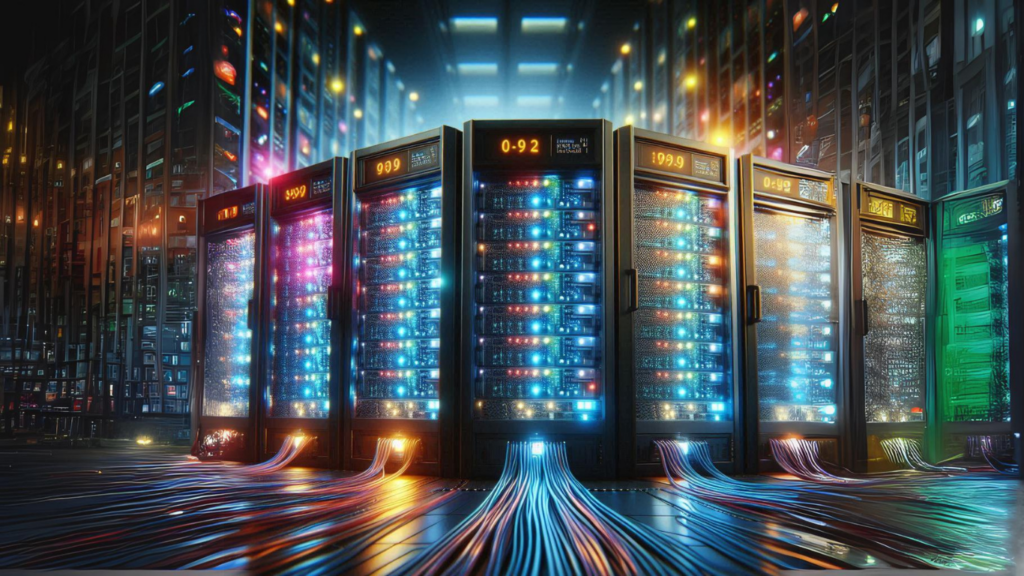
Image: Simulation of the Fagaku supermachine located at the RIKEN Computer Science Center in Kobe, Hyogo
Motivation for creativity
The introduction of the supercomputer “Fugaku Next” represents Japan’s efforts to pursue the pace of development of artificial intelligence (AI). It is considered an upgraded version of the Fugaku supercomputer, which once held the position of the world’s fastest supercomputer until it was overtaken by the American Frontier supercomputer in 2022.
The new supercomputer is expected to be operational by 2030 and is capable of reaching speeds 1,000 times faster than today’s most powerful supercomputers, according to Live Science.
Intermediary cooperation of functions
“Fugaku Next” will be developed by RIKEN and Fujitsu, who were involved in the production of Fugaku to increase compatibility with Fugaku. It is known that the latter version is more likely to use Fujitsu-designed parts. However, there has not been any confirmation on this issue and it is not possible to know the details of the parts that will be installed on the new machine.Challenge One of the biggest challenges that engineers face is figuring out how to operate the machine efficiently. In 2023, computer experts predict that a zeta-class machine using current supercomputing technology will require energy equivalent to the capacity of 21 nuclear power plants.
A Promising Future
If successful, Japan’s zetaFlops supercomputer will open up limitless possibilities for humanity. From exploring the universe to finding new cures for incurable diseases, supercomputers will play an important role in solving the world’s pressing problems.