News
Star1 – The fastest humanoid robot in the world
A Chinese robotics company recently launched Star1 – the fastest bipedal robot in the world, capable of reaching and maintaining speeds of up to 12.98 km/h.
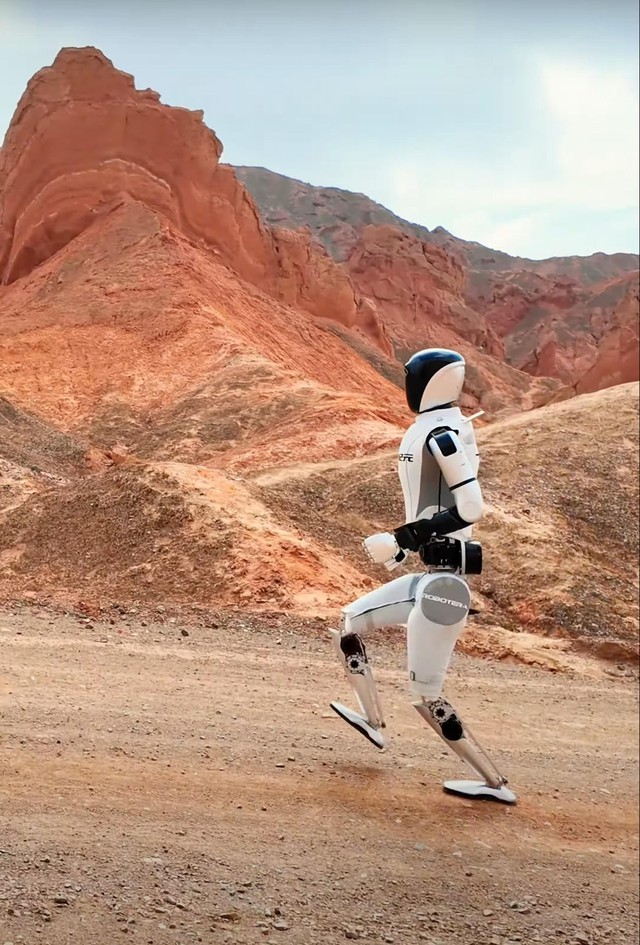
Robot Star1. Photo: O.C
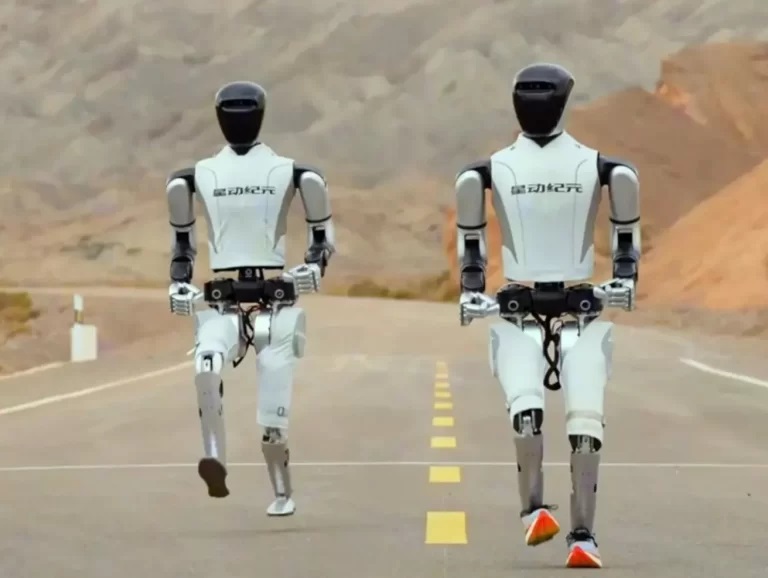
Last month, photos and videos of a robot in sneakers running through the Gobi Desert went viral on Chinese social media, impressing the public. However, few people realize that they are witnessing the fastest humanoid robot in the world in action.
Developed by a Chinese robotics company, Star1 is powered by high-torque motors, artificial intelligence (AI) algorithms, and can handle all types of surfaces and environments, including sand and grasslands. The advanced motors enable the robot to move efficiently, while high-speed sensors and communication modules allow the robot to process information about its surroundings in real-time.
The Star1 robot stands 1.68 meters tall, weighs 64.8 kg, and can run at a speed of 3.6 meters per second, making it the fastest bipedal robot ever created.
The superior technology behind Star1
The success of Star1 comes not only from its exterior design but also from its superior engine system and AI computing technology. The robots participating in the race are all equipped with a 400 Nm (295 lb.ft) engine, along with “precision planetary gear reducers, encoders, and high-precision drivers.” This allows Star1 not only to move flexibly but also to adapt well to various types of terrain.
In addition, Star1’s ability to perceive and process the surrounding environment comes from an advanced AI system with computing power of up to 275 TOPS. (Tera-Operations Per Second). This is a crucial factor that helps robots quickly respond to changes in the environment and maintain optimal performance.
And one more thing that helps Star1 surpass other bipedal robots in terms of speed is the human running shoes.
Specifically, Chinese scientists helped the robot achieve this impressive speed by creating a pair of classic running shoes for it. This made a significant difference.
In the tests, the robot wearing sneakers ran significantly faster than the barefoot competitor. Although starting slower, the robot in sneakers handled the difficult terrain of the Gobi Desert well and finished earlier. With a running speed faster than other advanced humanoid robots – such as Tesla’s Optimus, Boston Dynamics’ Atlas, and Unitree Robotics’ H1 robot, which had previously broken the speed record of 3.3 meters per second.
Video of Robot Star1 in sneakers easily crossing the Gobi Desert (Source: Youtube):
However, while the manufacturers of those robots focus on advanced sensors and complex motion algorithms, the Chinese Robot company has made significant progress by optimizing the running mechanism and using existing technologies like running shoes to improve traction.
Collected material: Newspaper